
Oxhy completes the Smart&Start program
With Invitalia’s site visit on May 5, 2026, Oxhy has entered the final phase of the Smart&Start Italia program, completing a strategic process of technological development and the establishment of its advanced prototyping laboratory.

On May 5, 2026, Invitalia, the program’s managing entity, conducted an on-site inspection to verify the expenditure plan for the Oxhy program — Application SSI0004946, CUP C26I24006890008.
This is one of the final steps required for the approval of the project’s final balance. Oxhy has, in fact, completed and reported on the final phase of a program that concluded ahead of the initially planned 24-month timeline, with a contractually approved expenditure plan of approximately €524,000 and a total contribution—comprising both subsidized financing and a grant—of approximately €420,000.
A key initiative to strengthen Oxhy’s technology platform
The Smart&Start project marked a decisive step toward consolidating the technical, experimental, and instrumental foundation necessary for the development of the Oxhycell.
Thanks to the program, Oxhy was able to implement a technological platform consisting of internally developed equipment and prototype systems, with the aim of facilitating the transition from a research and development phase to a pre-industrial phase and, subsequently, to commercialization.
The investments strengthened three areas in particular:
- material characterization;
- design of prototype systems;
- development of proprietary instrumentation for testing, manufacturing, and mechanical processing.
New capabilities for testing and characterizing materials
A significant portion of the program was dedicated to research and experimentation on the materials used in the cell.
These activities benefited from the acquisition of laboratory instruments for testing and characterization, including:
- FT-IR spectroscopy;
- integrated optical systems with a monochromator;
- metrological lamps covering various wavelength ranges;
- mid-infrared LEDs;
- thermopiles and photodiodes for optical experiments.
This equipment allows for the analysis of the behavior of different materials, including hydrogel matrices, and for a deeper understanding of the physical mechanisms relevant to the evolution of Oxhycell technology.
A prototype nanoindentation machine
When the solutions available on the market did not meet Oxhy’s experimental needs, the team decided to develop new instrumentation in-house.
Among the most significant achievements is the design and construction of a prototype nanoindentation machine, intended for measuring the elasticity of extremely soft and viscoelastic materials.
The system was designed to perform controlled measurements without inducing unwanted lateral deformations in the samples, a particularly important consideration when working with gels and soft materials.
The machine integrates dedicated electronic and mechanical components, including:
- control electronics;
- motion drivers;
- measurement chain with load cell;
- signal amplification;
- precision mechanics.
The system is already prepared for future upgrades, including the integration of ultra-high-sensitivity load cells and the implementation of proprietary software routines for automatic multi-point mapping of samples.
A multi-material prototyping platform for the fabrication of experimental devices
A second strategic outcome involves the design of a multi-material prototype 3D printer, intended to support the future production of functional components and subsystems for Oxhycell.
The machine consists of four multi-material print heads with independent axes and is designed as a modular four-tool system, featuring:
- high-dynamic XY kinematics;
- a multi-constraint Z-axis;
- automatic tool changer;
- capability to process thermoplastics, conductive materials, functional pastes, and hydrogels.
This platform is not only intended for geometric prototyping but also for the experimental fabrication of multi-material devices, paving the way for integrated processes of printing and assembling the various cell components.
The management of the four tools is handled by an automatic tool-changing system inspired by the logic of CNC machine tools. Inactive tools are housed in a dedicated parking system, while coupling with the moving carriage is achieved via a self-centering plate with high repeatability.
This architecture reduces process downtime, limits moving mass, minimizes the risk of collisions, and reduces cross-contamination between different materials.
CNC Machines for Advanced Mechanical Prototyping
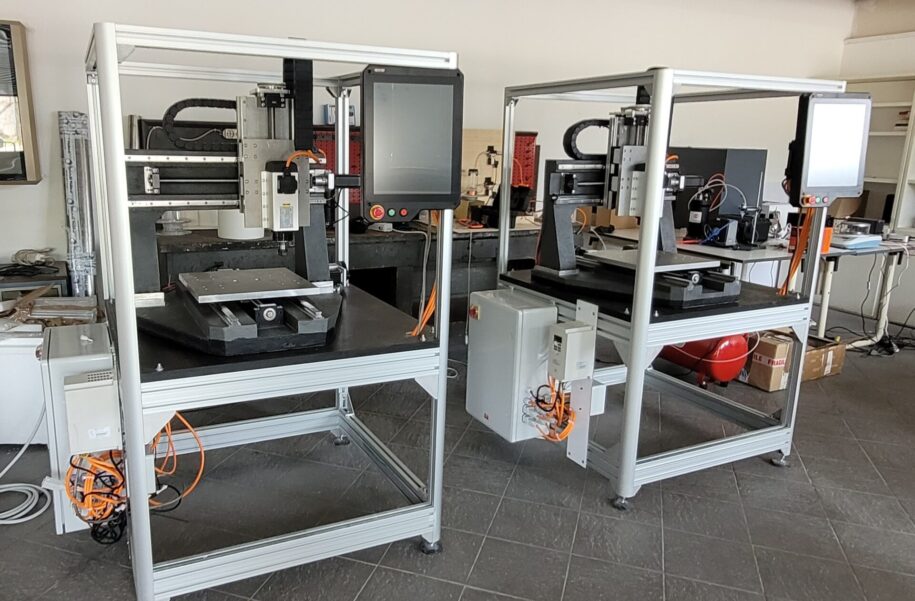
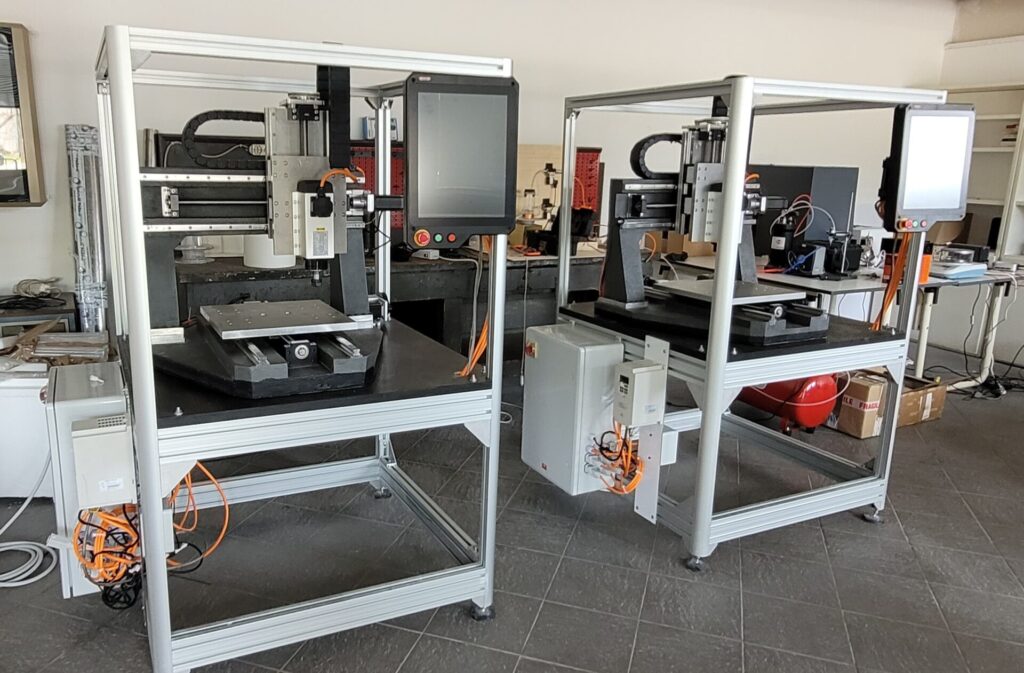
Another outcome of the Smart&Start program was the design and construction of two 4-axis CNC machines, designed to operate in prototyping environments. The goal was to equip the Oxhy laboratory with highly customized machining systems capable of working with tolerances in the hundredths of a millimeter on materials such as aluminum, engineering plastics, and brass.
The decision to develop the machines in-house stemmed from the need to directly control critical parameters such as structural rigidity, vibration damping, compactness, safety, and compatibility with a laboratory environment.
The machines offer a working volume of approximately 400 × 400 × 150 mm, with an overall footprint of about 1000 × 1000 mm and a total height, including the base, of approximately 1.7 meters. The kinematic configuration includes three Cartesian linear axes—X, Y, and Z—and a fourth rotary axis A, which allows for machining on cylindrical or oriented surfaces.
This infrastructure significantly expands Oxhy’s capacity to produce mechanical components, mounts, experimental parts, and subsystems necessary for the development of energy recovery devices.


From research to the pre-industrial phase
For Oxhy, the completion of the Smart&Start program represents much more than just an administrative milestone. It is a step that consolidates the company’s ability to design, test, characterize, and build in-house tools and functional prototypes for the development of Oxhycell.
The technology platform built through the program now serves as a solid foundation for tackling the next phase: the transition from structured experimental research to a pre-industrial engineering trajectory.
This path is essential for transforming the oxyhydroelectric cell from a cutting-edge technology into an application platform, with potential uses in distributed systems, sensors, industrial IoT, and low-power devices.
A foundational infrastructure for Oxhycell’s future
With the completion of the activities outlined in the Smart&Start program, Oxhy now possesses a range of expertise, tools, and prototyping systems that strengthen its experimental autonomy and accelerate its progress toward the next technological milestones.
The ability to integrate commercial instrumentation, in-house development, mechatronic prototyping, and multi-material manufacturing is a central element of Oxhy’s strategy. It is on this basis that the company intends to continue its development path, leading Oxhycell toward increasing levels of technological and application maturity.