
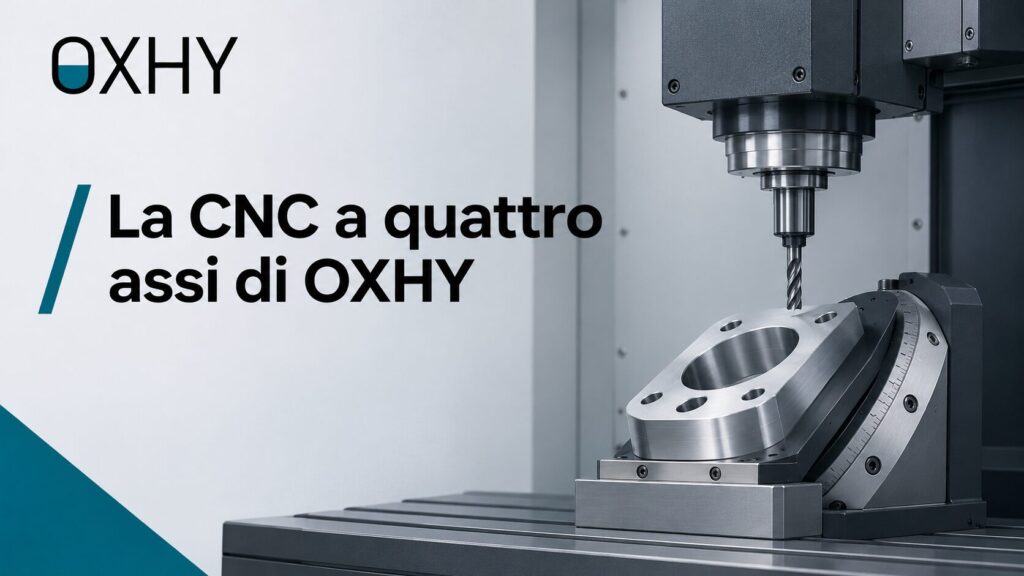
The four-axis CNC developed by OXHY
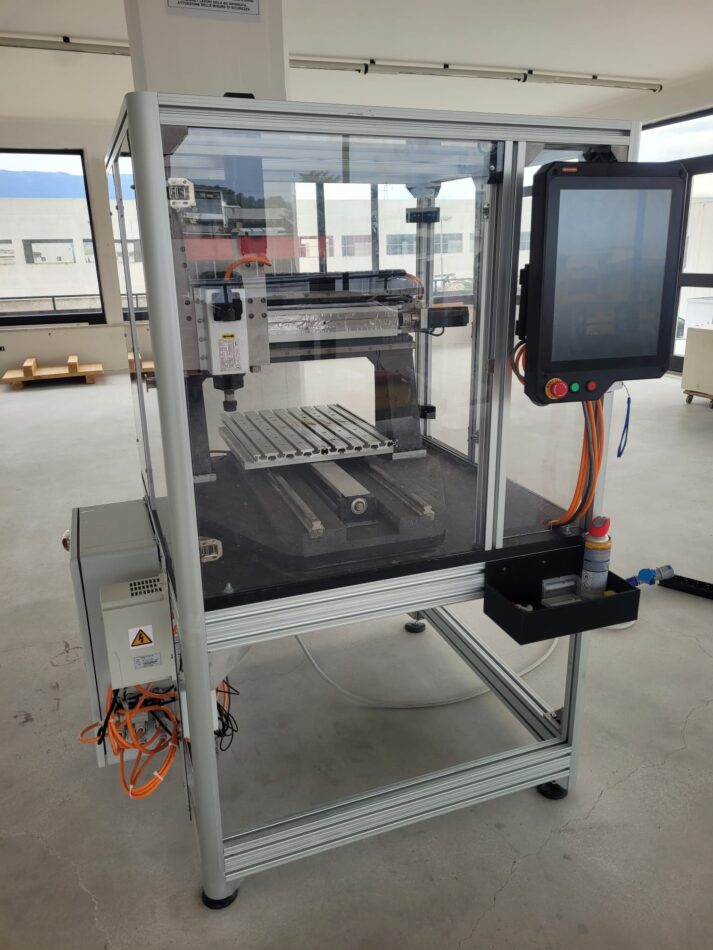
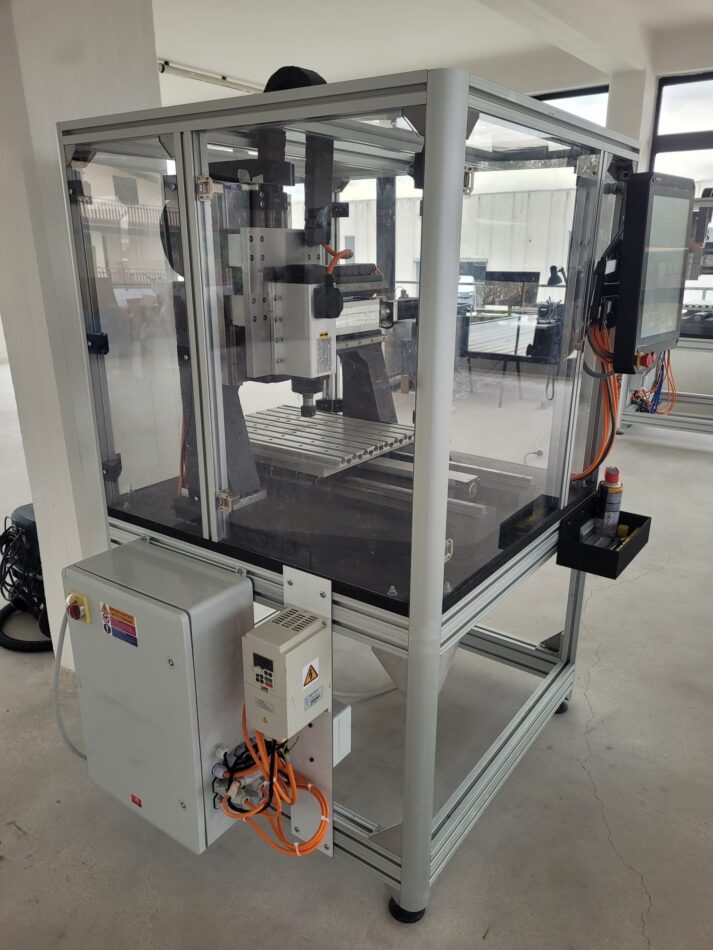
OXHY designed and built a four-axis CNC machine, developed to meet the specific needs of the laboratory and make the transition from design to experimentation more direct.
Developing a deeptech technology often means working on challenges for which standard tools, components or processes do not yet exist.
In the development of Oxhycell, alongside research into the underlying physical phenomena and materials, the ability to design and build increasingly precise components, supports, experimental equipment and integration systems in-house has become increasingly important.
The decision to develop it internally came from a practical need: when working on technologies that are still evolving, many mechanical parts are either not available as standard products or need to be repeatedly adapted based on experimental results. Relying exclusively on external suppliers can therefore introduce additional lead times, costs and constraints that slow down the development cycle.
The CNC allows OXHY to bring part of this manufacturing capability directly into the laboratory and respond more quickly when a component needs to be designed, produced, tested and then modified.
From design to physical component
A CNC (Computer Numerical Control) machine is a system in which movements and machining operations are managed through digital commands.
The machine developed by OXHY is a four-axis milling machine: in addition to movement along the three spatial axes, it features a rotary axis that allows the component to be repositioned during machining.
This configuration expands the range of operations that can be performed compared with a conventional three-axis machine, making it possible to work on different surfaces, handle more complex geometries and, in some cases, reduce the need to reposition the workpiece manually.
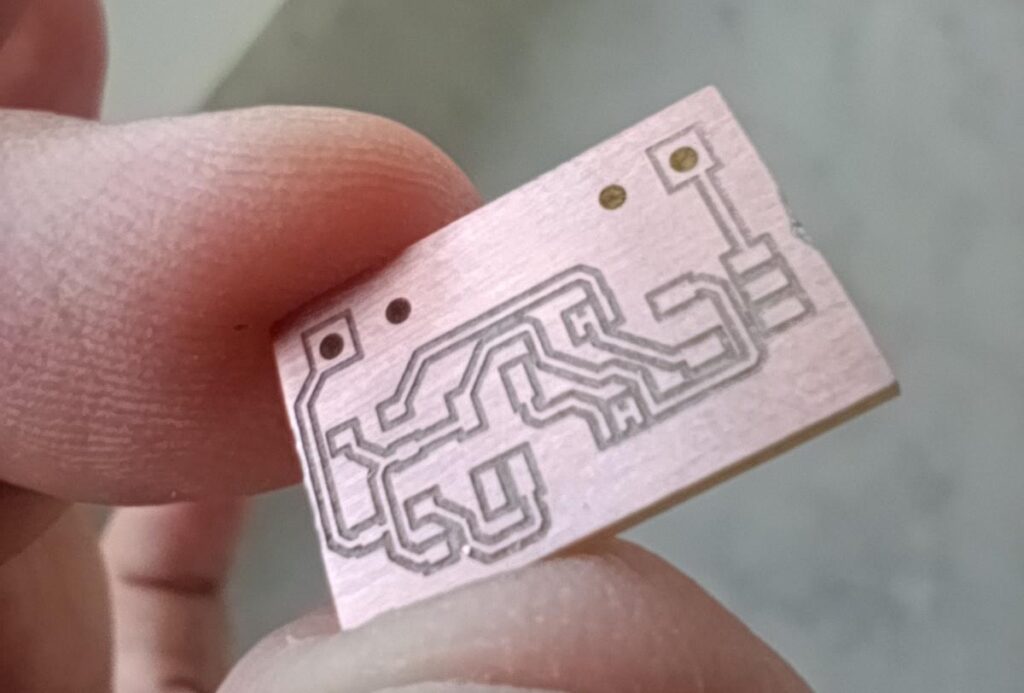
The system was designed to process materials commonly used in technical prototyping, including aluminium, brass and engineering polymers. Its applications include the production of customised mechanical parts, supports for experimental setups, precision components, connecting elements and dedicated tooling.
Several requirements particularly relevant to laboratory use were considered during the design process.
- Precision makes it possible to manufacture components with tolerances suitable for assembling experimental equipment and mechanical systems.
- The four-axis configuration provides greater operational flexibility, while compactness was a key design objective in order to make the machine suitable for a research and prototyping environment.
- The system also combines the ability to work with different materials with the integration of mechanics, motors, control electronics and software within a single platform.
Developing the machine required a complete process: from mechanical design and component selection to structural definition, manufacturing of parts, subsystem integration and commissioning. A significant part of the work focused precisely on integrating the mechanical structure, controlled motion, electronics and software, resulting in a fully functional system that can be used in OXHY’s internal activities.
The value of the CNC goes beyond the features of the machine itself: having this capability in-house reduces the distance between idea, design, manufacturing and validation. A component can be produced, used in a test and subsequently modified based on experimental evidence, supporting a more iterative and flexible development process.
This is particularly valuable when technical solutions are not yet fully consolidated and different configurations need to be explored quickly. In this sense, the CNC represents an investment not only in the production of individual components, but in OXHY’s broader experimentation and engineering capabilities.
Building capabilities, not just tools
The CNC is an enabling tool in Oxhycell’s and OXHY ORC’s technological and pre-industrial development path.
It can be used to manufacture components and tooling for prototypes, adapt experimental setups, produce customised mechanical supports and interfaces, modify systems already under development and build parts for demonstrators and integrated systems. Its development required the integration of expertise in mechanical design, materials technologies, automation, control electronics and manufacturing process management.
The result is therefore not simply a new machine available in the laboratory, but also a body of knowledge that remains within the team. The experience gained covers the entire process: identifying a need, designing a solution, building it, integrating it and verifying its operation. For a deeptech startup like OXHY, this step is particularly significant. Scientific research must progressively translate into increasingly reproducible physical devices, systems and processes, and the ability to design the tools needed along this journey increases both autonomy and control over technological development.
The CNC is also an example of collateral innovation: by working to solve a specific need within the Oxhycell programme, tools, capabilities and solutions can emerge that may hold value beyond the original challenge. This principle can extend beyond mechanical manufacturing to the design of experimental equipment, materials development, characterisation techniques and, more broadly, the production processes developed along the way.
The CNC therefore also reflects a broader evolution at OXHY: alongside research into electricity generation, the team is progressively building capabilities in design, prototyping and systems integration, strengthening its ability to turn scientific knowledge into physical, testable solutions.
In the next articles in “The Tools of Innovation”, we will highlight other machines and solutions developed in-house by OXHY to support research, prototyping and engineering.
Because innovation also means building the tools that make innovation possible.